Purple Day for Epilepsy takes place every year on March 26. To mark the global awareness day this year, Peter Roberts from BRAIN Involve has kindly shared his own story of being diagnosed with epilepsy and how he has supported neuroscience research at Cardiff University over the past two decades.
Peter’s first epileptic seizure was in the bathroom on 12th September 1994. It was followed by another seizure the next month and another in March 1995. Peter visited the hospital for a check-up and minor scan and no cause was found, but it was thought to be idiopathic epilepsy.
Peter said: “My doctor placed me on Epilim Chrono and I lost my driving licence for a year. As I worked in Aberdare and I had to travel to and from Barry, this caused a few problems, especially as commuting by train wasn’t totally reliable.
“I was taken off the tablets in 2006 but in 2007 I had another seizure and lost my licence again for a year. I have, as a precaution, stayed on Epilim ever since. To this day no cause has been found for my problem.”
Peter’s diagnosis of idiopathic epilepsy and the medication he takes to manage the condition have had an impact on his life.
He added: “Losing my driving licence has been the greatest inconvenience for me and I think Epilim has caused me recurring minor skin problems. It has also impacted my wife to a minor degree as she is always there to check I’m taking the tablets!”
After his diagnosis, Peter was asked to join the WERN group (Welsh Epilepsy Research Network): a group of people with epilepsy, led by doctors and researchers from Cardiff University, who met once a month to discuss their experiences and challenges.
Peter said: “Patients and family members were welcome at the WERN meetings which were held in Cardiff or Bridgend. One of the main doctors was Dr Cheney Drew and when this group folded, Cheney asked me if I would join BRAIN Involve. I gladly accepted and the rest is history.
“I have talked to researchers, students, and patients about likely problems and now meet people with Multiple Sclerosis, Parkinson’s Disease, and Huntington’s Disease.
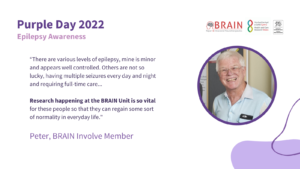
“There are various levels of epilepsy, mine is minor and appears well controlled. Others are not so lucky, having multiple seizures every day and night and requiring full-time care. This is bound to have an effect on their education, job prospects, and all that follows in their future life.
“Research, like the work happening at the BRAIN Unit, is so vital for these people so that they can regain some sort of normality in everyday life. I’m really pleased to play my part in supporting the research by being a member of BRAIN Involve.”
BRAIN Involve is a public involvement group made up of people who are, or have been, directly affected by neurological diseases such as epilepsy, Huntington’s disease (HD), Multiple Sclerosis (MS) or Parkinson’s disease (PD).
By bringing their personal experiences to the research table, members contribute to the design, development, implementation, and dissemination of the BRAIN Unit’s research around brain repair and developing new therapies for brain conditions.
Peter concluded: “Sharing our lived experiences of epilepsy and other neurological diseases at BRAIN Involve can really have an impact on shaping the neuroscience research happening at Cardiff University and increase awareness of these conditions.
“If any member of the public knows of a family member or friend within any of the four problem areas listed above, please come along to our next meeting. We are currently meeting virtually and you would be very welcome. Never be afraid of asking for help, there will always be someone only too glad to be of assistance.”
BRAIN Involve brings together patients, carers, and academics to shape cutting-edge research into neurological and neurodegenerative diseases. You can find out more about how to get involved on our website.
A special thanks to Peter for sharing his story for Purple Day 2022.
In the 2018-20 award, the BRAIN Unit received funding to develop an Electronic Patient Record (EPR) system supporting clinical care and deep patient phenotyping in Multiple Sclerosis (Cardiff and Vale and Aneurin Bevan), Parkinson’s Disease (Abertawe Bro-Morgannwg) and Epilepsy (Cardiff and Vale).
The system is deployed via a secure internet-facing server behind the NHS firewall, allowing researchers to securely collaborate and contribute patient-level datasets. Towards the end of the award, a new multi-disciplinary module for the epilepsy surgery programme (Cardiff and Vale) was deployed. The PatientCare database is now well integrated and has cross-disciplinary use, improving the care of patients.
Developing the EPR system
We now wish to expand on this platform to develop research-ready cohorts, where detailed diagnostic and clinical phenotype data is maintained alongside patients’ consent to be approached for research, and tissue biologicals, most commonly serum and plasma for genetic and other disease biomarkers are collected and stored.
A programme is already in place for Multiple Sclerosis for patients in South Wales led by Professor Neil Robertson, utilising a clinical database ‘PatientCare’ and the Wales Neuroscience Tissue bank. We are developing a similar pipeline for patients with epilepsy, the PatientCare database is already being used to capture diagnostic and treatment data as part of routine clinical care.
Additional funding from the BRAIN Unit will go towards extending this work to a formal research proposal with NHS Ethics and R&D approval for tissue and para-clinical (namely brain scan (MRI) and electroencephalograph (EEG)) data collection with patient consent for storage and onward research, for patients with epilepsy attending specialist clinical in Cardiff and Vale and Cwm Taf health boards.
This supports one of the main objectives and strengths of BRAIN, which is the close bidirectional link between academic research and routine NHS clinical care, giving access to patients with neurological conditions attending outpatient clinics into clinical research and clinical trials.
Expanding the team
To execute this research, we welcomed Valerie Anderson to the BRAIN Unit team, to support an epilepsy clinical database and sample collections setup, initially working on the protocol, ethics and R&D approvals.
This will be of benefit to other researchers in epilepsy, who will have access to the data and samples collected, create research-ready cohorts for clinical trials and studies as they develop, that would be available for any BRAIN Unit investigators and outside collaborators. And it will open opportunities for collaborations with other research initiatives in the UK and internationally.
Valerie previously established a similar project in Multiple Sclerosis. Her experience and knowledge from doing this will allow us to proceed at pace in getting things set up for epilepsy, and then to work further on the running of the project once set up.
Once established, as envisaged within the 12 month funding period recruitment, consent, sample collection and data collation would continue through standard clinical encounters. Data would be available for research and follow-on funding would be sought for both infrastructure and project-specific support.

