An incredible new film shows the human brain in unrivalled detail, thanks to a partnership between Cardiff University and Siemens Healthineers.
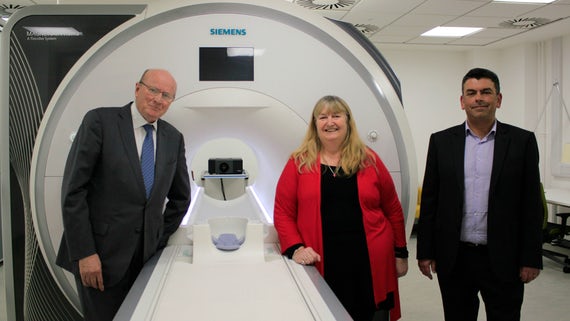
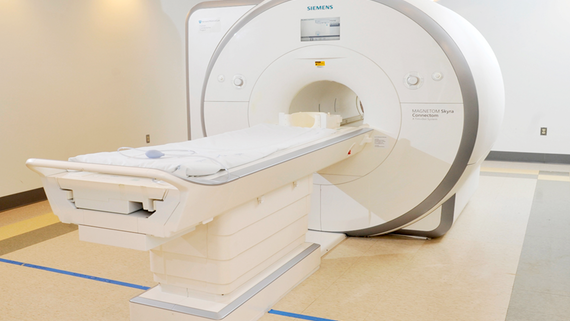
BBC Medical Correspondent Fergus Walsh’s brain was scanned at Cardiff University Brain Research Imaging Centre (CUBRIC) using Europe’s most powerful MRI scanner – the Magnetom Skyra Connectom 3T.
Cinematic rendering
Siemens Healthineers used the scan data to produce amazing images of Fergus’s brain by adapting a technique used in the film industry known as cinematic rendering. These images provide a stunning new view of the pathways taken by the white matter, revealing the complex set of connections that underpin brain function.
Another volunteer to be scanned was Sian Rowlands who has multiple sclerosis. Conventional scans clearly show lesions – areas of damage – in the brain of MS patients. But the advanced scan, showing axonal density, can help explain how the lesions affect motor and cognitive pathways – which can trigger Sian’s movement problems and extreme fatigue.
Professor Derek Jones, Director of CUBRIC, said:
“The incredible detail shown in these scans highlight the possibilities available to the talented CUBRIC team which now has access to the most advanced equipment of its type in the world.
“The microstructural scanner will be used for research that will potentially have a profound positive impact on the lives of people around the world…”
“At CUBRIC we are looking to provide unprecedented insights into the causes of neurological and psychiatric conditions such as dementia, schizophrenia and multiple sclerosis, as well as understanding the workings of the normal, healthy brain.” Professor Derek Jones, Director of CUBRIC
CUBRIC brings together expertise that has established Cardiff University as one of the UK’s top three universities in the UK for Psychology, Psychiatry and Neuroscience, alongside Oxford and Cambridge universities.
The best neuroimaging equipment in the world

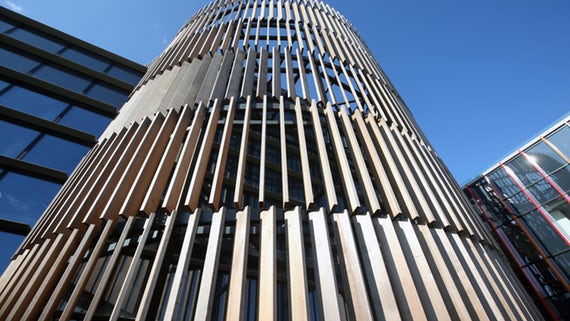
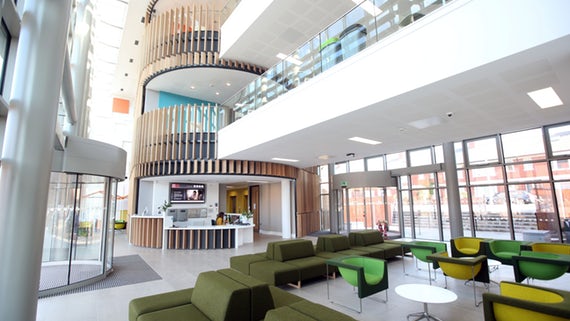
The £44 million Centre, designed by global architecture and technology practice IBI Group, and built by construction firm BAM, is four times larger than the University’s previous brain research imaging facilities. It houses the best neuroimaging equipment in the world to help unravel the mysteries of the human brain.
The new facility has been part-funded by the Engineering and Physical Sciences Research Council (EPSRC), the European Regional Development Fund through the Welsh Government, the Medical Research Council (MRC), the Wellcome Trust, the Welsh Government and the Wolfson Foundation.
Together, these investments are supporting innovation in world-class brain imaging research, including the creation of highly-skilled research jobs in Wales.
Cardiff University Brain Research Imaging Centre (CUBRIC) is one of just four projects shortlisted for this year’s National Eisteddfod Gold Medal for Architecture.
The Gold Medal for Architecture recognises the importance of architecture in the nation’s culture and celebrates the highest standards of architectural design in the country.
The shortlist of four building projects, located across Wales, was unveiled at a reception hosted by the National Eisteddfod of Wales and supported by the Design Commission for Wales and Royal Society of Architects.
After further deliberation over the coming month, just one of the shortlisted buildings may be awarded the Gold Medal for Architecture on 5 August 2017 at the National Eisteddfod of Wales in Anglesey.
CUBRIC, designed by the global IBI Group, has already won a clutch of awards including Project of the Year and Design through Innovation at the 2017 RICS Awards and a major science buildings award at the 2017 S-Lab Awards.
-

- A Royal opening for CUBRIC in 2016
CUBRIC is home to powerful MRI scanning facilities, brain stimulation equipment, sleep laboratories, modern offices and break-out spaces.
The £44m facility was officially opened by Her Majesty The Queen in 2016.
Cardiff University’s Fluoxetine, Learning and Memory in Epilepsy (FLAME) team invites people with mesial temporal lobe epilepsy (TLE) to take part in a research study.
The trial explores a potential treatment to improve learning and memory difficulties in people affected by TLE, a common problem for individuals living with this condition.
There are currently no treatments available to combat learning and memory issues in TLE. We know that new brain cells are constantly being formed (neurogenesis) in the brain’s hippocampus, which is important for learning and memory. We also know that there is less neurogenesis in people with severe TLE, which may help to explain some of the difficulties patients report.
Research aims
Previous research has shown that a widely used medicine called fluoxetine can restore the production of new cells in the brain. It can also restore the ability to learn a difficult learning task in an animal model of temporal lobe epilepsy that shows the same patterns of learning and memory problems seen in people with TLE.

FLAME is examining whether fluoxetine can improve learning and memory in a similar way in patients with TLE.
Between now and February 2018, the FLAME team aims to recruit up to 20 patients with TLE to participate in this trial. Interested volunteers will be invited to attend the University Hospital of Wales (UHW) for an initial eligibility assessment, which will involve a blood test, questionnaires and an MRI scan. Suitable participants will then be invited to complete a series of learning and memory tasks at Cardiff University both before and after a two-month course of fluoxetine treatment.
The team would like to hear from anyone (aged 18-65) with a TLE diagnosis who is willing to travel to Cardiff to complete a series of learning and memory assessments (travel expenses paid).
“There are currently no effective treatment options available for memory and learning problems in patients with TLE,” said Dr Mark Postans, Research Associate at Cardiff University’s Neurosciences and Mental Health Research Institute (NMHRI).
“By testing the clinical effectiveness of a cheap, widely available and well-tolerated drug to combat these issues, FLAME addresses an important unmet clinical need and may one day help those living with this form of epilepsy.”
Funders
FLAME is funded by Epilepsy Research UKand the BRAIN Unit, and led by the project’s Chief Investigator, Professor William Gray. The study received ethical approval from Cardiff University, Wales NHS Research Ethics Committee 3, the Medicines and Healthcare products Regulatory Agency (MHRA) and the Research and Development Office of Cardiff and Vale University Health Board.
Anyone interested can contact the FLAME trial team to discuss the trial or request an information booklet by email FLAME@cardiff.ac.uk or call 02920 688 590.
Three talented rising stars of microstructural MRI have each secured highly prestigious fellowships to study at the Cardiff University Brain Research Imaging Centre (CUBRIC).
Maxime Chamberland (Sherbrooke University, Quebec), Erika Raven (Georgetown University, Washington DC), and Chantal Tax (Utrecht Medical Centre, Utrecht) will start their fellowships this year in the newly built, state-of-the-art centre.
Prof Derek Jones, mentor to all three Fellows, said:
“I am absolutely thrilled by the success and high calibre of these three Fellows, and in particular, that they have chosen to hold their Fellowships in CUBRIC at this important stage in their career development…”
“I am excited by the research proposals from each of the Fellows, and really look forward to working with each of them here in an increasingly international CUBRIC!” Professor Derek Jones, Director of CUBRIC
World-leading expertise
Dr Chamberland secured a Fellowship from the Natural Sciences Engineering and Research Science Council (NSERC) of Canada to develop fast, interactive tools for exploring brain fibres and brain connectivity, and was ranked first out of his application round. He said:
“As a computer scientist, I am interested in developing cutting-edge methods that will ultimately improve neurosurgical outcome. Although there are many centres in the world, I carefully selected CUBRIC as the host institution for my proposed research project…”
“Given its world-leading expertise, combined with world-leading equipment, CUBRIC is the perfect environment to develop my career and work with the best possible neuroimaging data to explore the limits of what might be possible in the human brain.”
Dr Maxime Chamberland, Sherbrooke University, Quebec
First Connectom MRI scanner in Europe
Dr Tax secured a Rubicon Fellowship from The Netherlands Organisation for Scientific Research (NWO), again ranking first in her round, for her proposal to exploit ultra-strong gradients in multi-modal MRI for assessment of white matter microstructure. She said:
“I have a passion for unravelling the brain’s structure. The unique equipment and multidisciplinary academic environment at CUBRIC is ideal for building upon the experience and tools from my PhD in diffusion MRI…”
“CUBRIC also hosts the first Connectom MRI scanner in Europe. Motivated by the potential of this system, the expertise of my supervisor Professor Derek Jones, and the similarities between my interests and the research lines at CUBRIC, I selected CUBRIC to hold my Fellowship.” Dr Chantal Tax, Utrecht Medical Centre, Utrecht
US-UK research collaboration
Dr Raven won the only Marshall Sherfield international Fellowship from the US to look at the iron content of brain tissue, and how this relates to cognition. She said:
“The CUBRIC facilities are incredible, and I am excited to learn from the large assembly of experts that make up the group…”
“The mission of my fellowship is to promote US-UK research collaboration. CUBRIC has been very active in hosting international meetings, notable speakers, and local community events like the brain games. I think this will be an excellent place for both academic growth, and meeting new colleagues.” Dr Erika Raven, Georgetown University, Washington DC
Located on Cardiff University’s Innovation Campus, the Brain Research Imaging Centre houses a combination of neuroimaging equipment unique within Europe, allowing the University to further its world-leading research and reputation as one of the UK’s top three Universities for Psychology, Psychiatry and Neuroscience.

