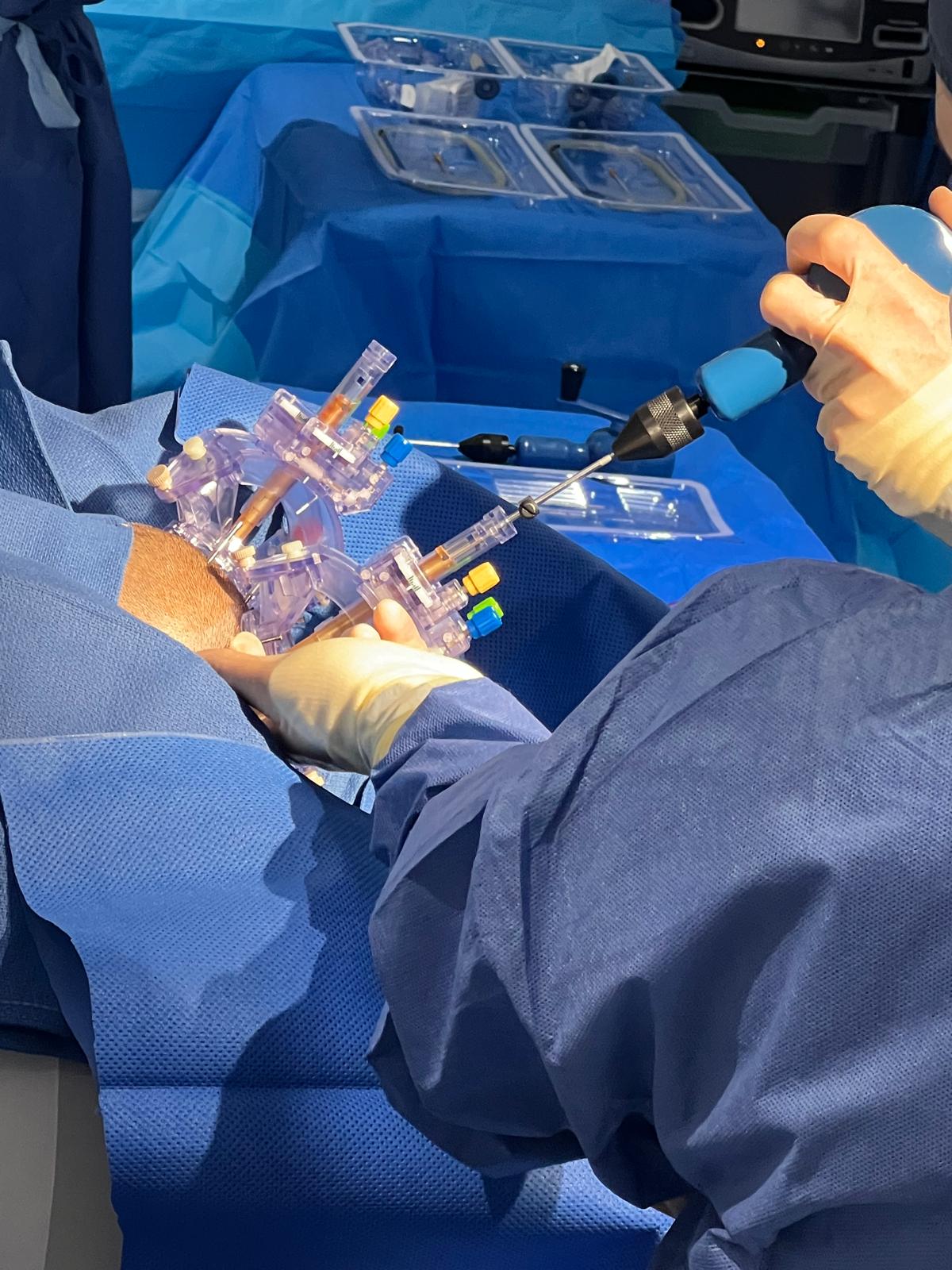
Our active research programmes help us understand and optimise therapy delivery. This ranges from advanced magnetic resonance (MR) imaging and modelling, to developing better surgical devices and refining clinical trial design.
We are focussed on ensuring that these critical early clinical trials don’t fail because of inadequate delivery. This work aims to bring the promise of these ground- breaking therapies into clinical reality for our patients.
The blood-brain barrier blocks most ATMPs from reaching the brain through the blood stream. However, there are different ways we can deliver advanced therapies during clinical trials.
Delivers therapies to the brain through the blood, via a cannula inserted into a vein. We use this for ATMPs that we know will cross the blood-brain barrier.

Delivers therapies directly to the cerebrospinal fluid (CSF) that surrounds the brain, via a lumbar puncture, which is when a needle is inserted into the lower back, between the bones of the spine.

Delivers therapies directly to specific areas of the brain using surgically placed devices while the patient is in an MRI scanner, to see exactly where the therapy is going in real-time. We are the only centre in the UK (and one of just five worldwide) with the expertise and facilities to safely deliver these neurosurgical treatments.
Treating participants with frontotemporal dementia with GRN gene mutations, sponsored by AviadoBio.
For further information about the study and eligibility criteria, there are two referring centres, in London and Cambridge. For London, please contact the referring centre at the UCLH NIHR Clinical Research Facility, in the Leonard Wolfson Experimental Neurology Centre at the National Hospital for Neurology and Neurosurgery. Enquiries can be directed to genfi@ucl.ac.uk.
For Cambridge, please contact the referring centre at Cambridge University Hospitals NHS Foundation Trust. Enquires can be directed to CUH.dementiatrials@nhs.net.
A study of AB-1005 (AAV2-GDNF) gene therapy in adults with moderate Parkinson’s disease sponsored by AskBio.
For further information about the study and eligibility criteria, please contact the referring centre at the North Bristol NHS Trust – Southmead Hospital (Neurology) Bristol. Enquiries can be directed to Dominika.Kruszynska@nbt.nhs.uk , or the research office by contacting 0117 414 8276.
AMT-130: The first gene therapy clinical trial in Huntington’s disease sponsored by UniQure.
Be Part of Research is a free service which makes it easy to find and take part in vital health and care research across the UK.
Learn how you can participate in research and clinical trials in the UK: bepartofresearch.nihr.ac.uk
Search for: